Ragn-Sells is one of the Nordic region’s largest environmental and waste management companies, with operations throughout Sweden as well as in Norway, Denmark, and Estonia. The Group processes several million metric tons of waste each year, both to convert materials into new raw materials and to remove substances that should not be returned to society. For a company whose business is based on the circular economy, securing its own energy supply is a natural part of that same approach.
In the video about the project, Emma Westling, project manager at Ragn-Sells, explains why SBP was chosen and what made the site particularly challenging. Watch the video about the project.
The experience gained at headquarters was the deciding factor
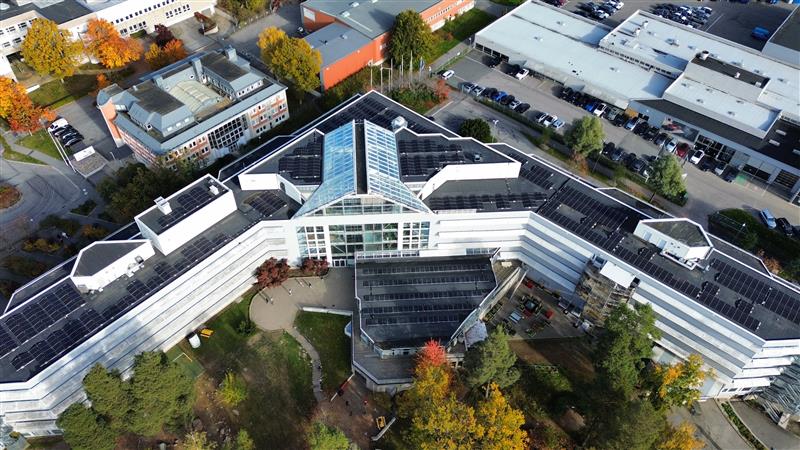
The partnership did not begin with this facility. Ragn-Sells already has solar panels at its headquarters in Sollentuna—also supplied by SBP—and the experience gained there was the deciding factor in who was chosen for the Brännbacken project.
“Our partnership with SBP is entirely based on the fact that we also have solar panels at our headquarters. So when I was tasked with installing solar panels at one of our waste treatment facilities, SBP was recommended to me by the people who handled the project at headquarters,” says Emma Westling, project manager at Ragn-Sells.
A place with its own demands
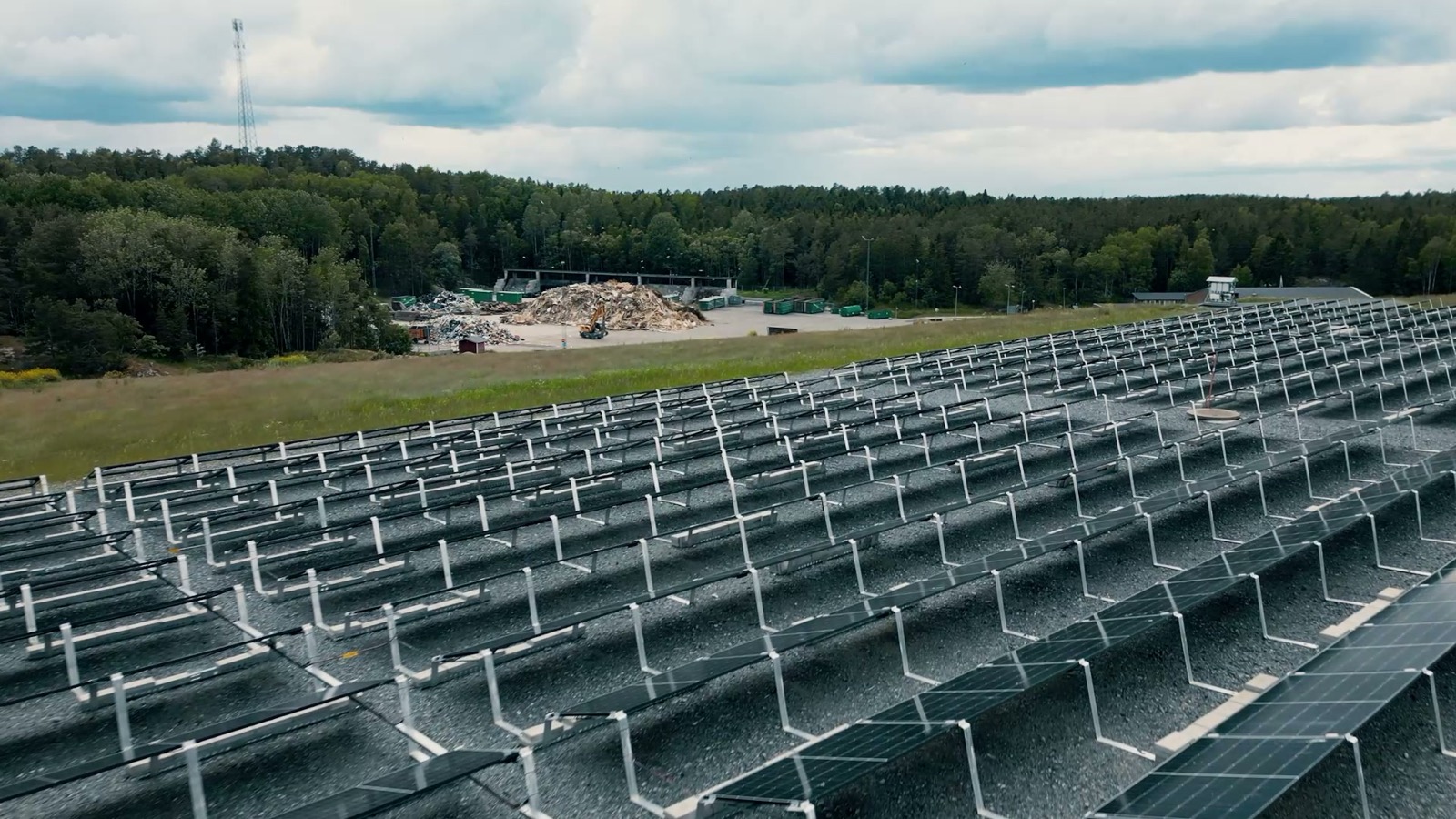
A roof is rarely just a roof, and a waste management facility with a landfill is something entirely different. The regulatory framework is extensive, the permit conditions dictate what can be done on-site, and operations cannot be halted simply because installation work is underway. This has a far greater impact on design, mounting, and the schedule than in a typical commercial project.
“We probably haven’t been the easiest clients to work with, because there are so many rules and requirements we have to follow. SBP hasn’t made it complicated—they’ve just made everything simple,” says Emma Westling.
Operating Power
With 303 kW of installed capacity and just over 270,000 kWh per year, the primary goal is a high level of self-consumption. A waste treatment facility has a steady demand for electricity during the day, which is the usage pattern where solar energy offers the best economic returns: each kilowatt-hour produced replaces a purchased kilowatt-hour subject to the full grid fee and full tax, rather than being sold back to the grid at the spot price.
“Of course, we also hope to be able to use a very large portion of this energy ourselves at our facility. And hopefully—maybe not to the point of being self-sufficient—but on really sunny days, most of the energy used at the facility will probably come from our solar panels,” says Emma Westling.
This production also has an impact on the company’s climate reporting. When self-generated electricity replaces purchased electricity, it is immediately reflected in the company’s emissions calculations, which—for a company with explicit climate goals—is a measurable result rather than a mere statement of intent.
What Determines Whether the Next Project Will Happen
For a company with operations in many locations, technology is rarely the bottleneck. What matters most is how much time each project requires internally: who will answer questions, maintain contact with the municipality, and ensure that the work does not disrupt day-to-day operations. Ragn-Sells already had experience with SBP from its headquarters in Sollentuna, and when it was Brännbacken’s turn, the recommendation came from there.
“I would recommend SBP to other companies because they offer a complete solution and they do it in a very straightforward way,” says Emma Westling.
SBP assumes full responsibility from analysis and design through installation, commissioning, and ongoing service. For real estate and industrial companies that want to get started without tying up capital, there is Energy-As-A-Service, which provides a comprehensive solution covering the system, financing, and operational responsibility.
The full interview with Emma Westling can be seen in the film about the solar cell project in Brännbacken.
Would you like to know how much energy your rooftops and facilities can actually generate? Contact us for an assessment of your green potential.